
Why Track Fetal Movement? What the Evidence Says
A change in a baby's usual movements can sometimes be a sign that something needs attention, which is why health bodies tell you to learn your baby's pattern and act on a change. Whether formal kick counting helps is less settled: a Cochrane review found no clear effect on stillbirth, and the NHS says counting is not needed.
Written by the Bumpi Kicks team at Speed AI Labs LLP. Last updated . General information, not reviewed by a clinician, and not medical advice. How we write and check these pages.

What is and is not known
A change can be a warning
The RCOG says reduced or changed movement may sometimes be a sign that a baby is unwell, and the NHS says a baby who is not well may be less active than usual.
Your baby's usual pattern is the comparison
The NHS says the important thing is to get to know your baby's usual pattern from day to day. The RCOG says no specific number of movements is considered normal.
Counting is one way to notice, not the only way
ACOG says your provider may ask you to keep track and will tell you how. The NHS says you do not need to count.
The evidence on counting is limited
The 2015 Cochrane review found no clear difference in stillbirths, with studies too few and too weak to be sure, and less anxiety among women who counted. It also notes counting can cause considerable anxiety for some women.
A record can help a conversation
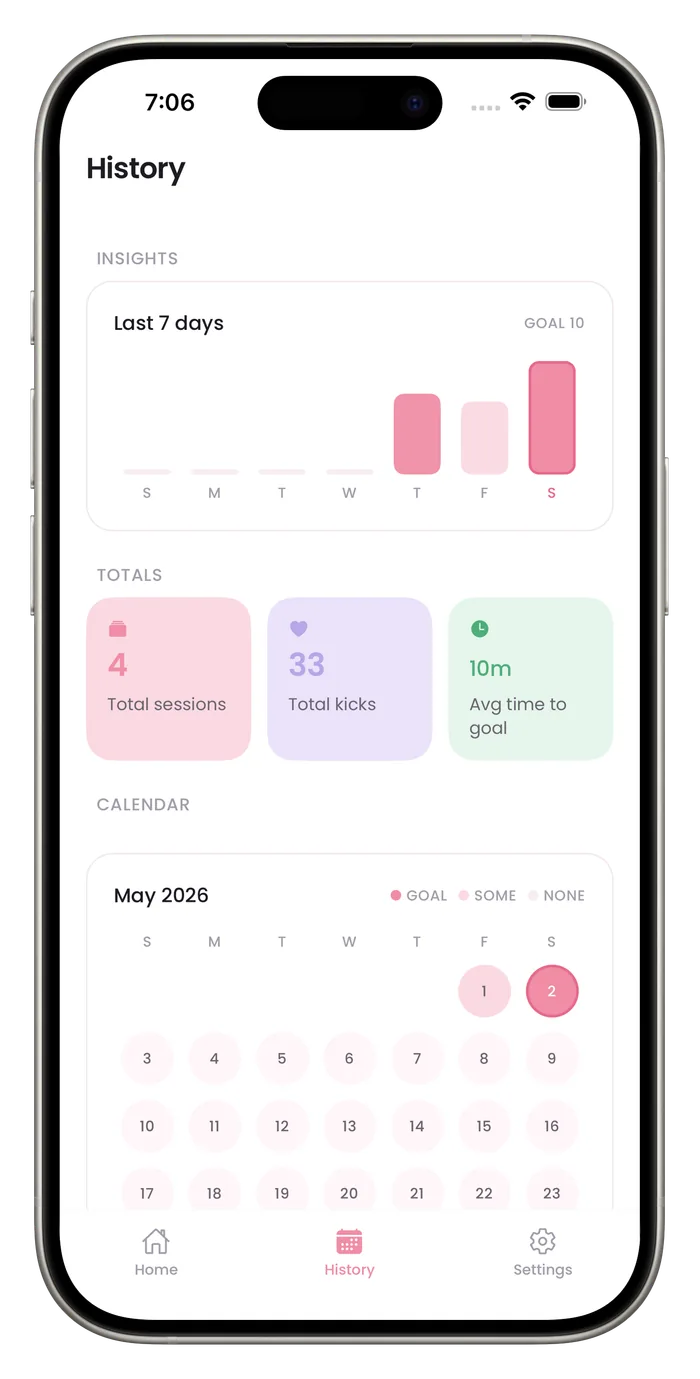
A log of dates, times and counts gives your provider something specific to look at. This is a practical benefit, not a proven medical one.
Common questions
Does counting kicks reduce stillbirth?
The Cochrane review found no difference in stillbirths between routine counting and mixed or undefined counting, but its studies were too few and too weak to assess stillbirth accurately. It is not proof that counting helps, and it is not proof that it does not.
Can counting make me more anxious?
It can for some women, according to Cochrane, although the one study that measured anxiety, with 1,013 women, found less anxiety among the women who counted. If counting makes you anxious, tell your provider.
Sources
These are the sources behind the statements on this page. We opened each one and checked it on the date shown.
- Royal College of Obstetricians and Gynaecologists, Your baby's movements in pregnancy (patient information based on Green-top Guideline No. 57, February 2011)
The RCOG says that if your baby moves less than usual or the pattern changes, it is essential to contact your midwife or maternity unit immediately, and that over 28 weeks you must not wait until the next day.
Limits: UK patient information published February 2019 and based on a 2011 guideline. The RCOG published a second edition of the guideline in 2026, which this site has not read. Advice elsewhere differs, and your own midwife or doctor comes first.
Checked . Read directly from the source.
- NHS, Your baby's movements, page last reviewed 8 July 2024
The NHS says that if your baby is not well, they may be less active than usual.
Limits: NHS advice is written for the UK. Advice elsewhere differs, and your own midwife or doctor comes first.
Checked . Read directly from the source.
- NHS, Your baby's movements, page last reviewed 8 July 2024
The NHS says there is no set number of movements you should feel each day, that you do not need to count your baby's kicks, and that you should get to know your baby's usual pattern.
Limits: NHS advice is written for the UK. Advice elsewhere differs, and your own midwife or doctor comes first.
Checked . Read directly from the source.
- American College of Obstetricians and Gynecologists, Special Tests for Monitoring Fetal Well-Being (FAQ098), last reviewed January 2026
ACOG's patient page says your health care professional may ask you to track movements if you feel them less often than normal, that there are different ways to do kick counts, and that your professional will tell you how often to count and when to call.
Limits: This page gives no number of movements and no time limit. Other ACOG documents may describe specific methods.
Checked . Read directly from the source.
- Mangesi L, Hofmeyr GJ, Smith V, Smyth RMD. Fetal movement counting for assessment of fetal wellbeing. Cochrane Database of Systematic Reviews, 15 October 2015
A 2015 Cochrane review of five studies (71,458 women) found them too few and too weak to assess stillbirth accurately, with no difference between routine and mixed or undefined counting, and less anxiety in one study of 1,013 women.
Limits: The review is about ten years old and pools studies that used different counting methods. It calls for more research comparing routine and selective counting, and it notes that counting tests can cause considerable anxiety for some women.
Checked . Read directly from the source.
Start a daily record today.
Bumpi Kicks keeps a simple log of your kick counts that you can look back on and show your care team.
Free to download. Counting needs a Pro subscription, and the App Store paywall shows the price and any free trial before you pay.